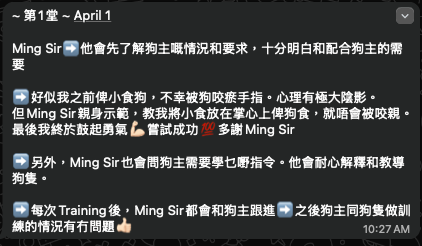
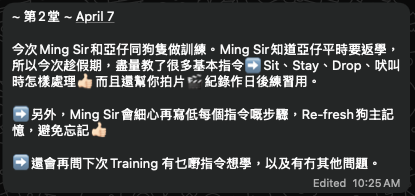
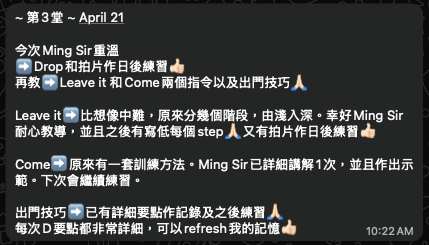
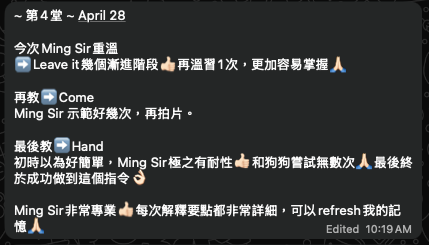
Learn The 11 Essential Commands
Eleven commands your dog will actually use — taught so they still work next month, in the lift, on the street, and when there's a chicken bone on the pavement.
The problem with "my dog knows sit"
Most dogs know sit. What they know is "sit is what happens when a human is holding food" — so the moment it counts, the command isn't there.
A command only counts when it works with distraction, at a distance, and with nothing in your hand. That's what these five lessons build.
The eleven, and what each one buys you
| Command | What it's actually for |
|---|---|
| "name" | The one everything else sits on — their attention, before you ask for anything at all |
| sit | A default parking spot: at the kerb, in the lift, when a guest comes through the door |
| down | For the longer waits — under the table while you finish your coffee |
| stay | Holds that position while you open the door, pay, or pick up the poo bag |
| pen | Sends them to their pen or bed on cue, instead of you carrying them there |
| off | Four paws back on the floor — off the sofa, the counter, your visitor |
| leave it | Before it goes in the mouth. The chicken bone you spotted first |
| drop it | After it goes in the mouth. The chicken bone you didn't |
| recall | Comes back the first time you call, from a distance that would matter |
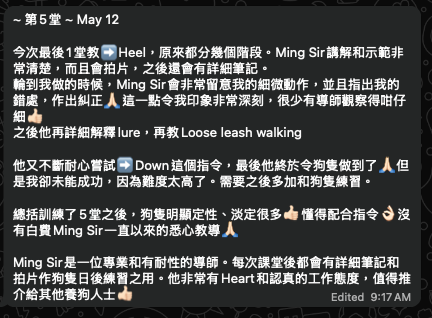
| heel | Walks in position past the thing they wanted to lunge at |
| loose leash walking | An ordinary walk where nobody is being dragged |
Two things that aren't commands
Eleven commands don't cover everything a new dog needs, and two of the most important aren't commands at all — so they don't get a number. They're in the five lessons anyway.
- Being handled — paws, ears, collar, harness, and the vet's hands. A dog who can't be held still can't be checked for ticks, can't have a harness put on without a wrestle, and turns every vet visit into a fight. Taught as something your dog agrees to, not something they put up with. The collar grab matters most of all: the day they slip past you at the door, it's the only thing that brings them back.
- A soft mouth — puppies use their teeth. The job isn't to stop it overnight, it's to teach them how hard is too hard while they're still young enough to learn it. With an older dog who was never taught, the work is redirection instead.
Why they'll still work next month
Anyone can get a dog to sit today. The reason these hold is the method underneath them, and you learn it as we go:
- Marker word — how to tell your dog "yes, that" in the split second it's true
- Release word — how to end a behaviour cleanly, so "stay" means something
- Lure, target, shape, capture — the four ways to start any new behaviour
By the last lesson you'll teach your dog a brand-new trick I've never shown you, using only what you've learned. That's the test of whether it stuck — not whether your dog sits while I'm standing there.
Booking
HKD 2,500 · 5 lessons · HKD 500 each
Taught in your home and on the streets you actually walk, because that's where the commands have to work.
Who it's for
- Your dog performs at home and ignores you outside
- You want commands you'll genuinely use, not a party trick list
- You'd rather learn to train than keep hiring someone to do it for you
Quick questions
My dog already knows sit and down. Is this still worth it?
Usually yes, because "knows it at home" and "does it outside" are different skills. We start where your dog actually is and spend the time on distraction, distance and dropping the food from your hand, rather than teaching a sit you already have.
Will I need treats forever?
No. Food does the teaching, the marker word does the telling, and then the food thins out. Carrying treats is how you start, not how you finish.
Is my dog too old for this?
No. All eleven work at any age — an adult dog often learns faster than a puppy, because they can concentrate for longer. A soft mouth is the one thing with a deadline: past puppyhood we redirect the biting rather than teach the bite, which is a different job.
Do we cover all eleven in five lessons?
We cover all eleven, but the point isn't to tick them off. Some come quickly; the ones your dog finds hard get the time, and you leave able to finish the rest yourself.
Am I being taught, or is my dog?
Both, but you're the one learning the method. That's the point of the final lesson: you teach your dog something I've never demonstrated, using only what you've picked up.
Reviews